
Home...> Articles 5...> Solid Fuel Cookers And Heat Storage Cookers...> Solid Fuel Cookers And Heat Storage Cookers 2
|
||
Solid Fuel Cookers
|
|
Larger cookers have four ovens to cope with roasting, baking, simmering and plate warming all at once. Obviously this is ideal for a busy cook with a large family or one who does a great deal of entertaining. Most solid fuel cookers have both a fast-boiling and a simmering hotplate, otherwise hotplates have to be controlled for both rates of heating. |
|
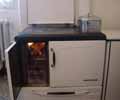
Thus even heat, both great and slow, is available on the cooker top as well as in the oven. On a four-oven cooker it is easier to use the oven for cooking root vegetables, first bringing them to the boil on the fast-boiling plate, and boiling for 3-4 minutes only, before putting into the moderate or baking oven. If you have a two-oven cooker, leave the pan on top for 2-5 minutes longer before draining and putting into the slow or bottom oven.
With these cookers you will find that you use the oven far more than on an ordinary gas or electric cooker. The ovens are deceptively large as the go back a very long way.
Another advantage is the ease with which the cooker can be cleaned. If anything is spilt in the oven, or on the hotplate, leave the mess to carbonise. It can then be brushed away with a stiff wire brush.
Pot and Pans
To obtain the best results it is most important to use the correct kind of pan. Enamelled iron casseroles are ideal for use here as they withstand heat in the hottest oven and they also retain heat well. Do not put pans with plastic handles into the hot oven. All types of aluminium or cast-iron pans are suitable for the hotplate so long as they have dead flat, machine-ground bases. Some pans are designed to stack one on top of the other while in the oven, thus allowing for cooking several dishes at the same time.
Above all, the instruction book provided with the cooker must be carefully studied as many valuable hints are given, such as the best use of the slow oven where stocks and stews can be put to simmer overnight, or the fact that milk must not be put to heat unwatched on the fast-boiling hotplate as it can boil over in one minute and so dirty the cooker top.
Hot Water Facilities
Your cooker need not be confined to serving your needs in the kitchen. If you choose, it can be used to heat domestic hot water, and some solid fuel cookers will also heat two radiators as well.
These solid fuel cookers are more expensive to run than those which can be switched off when not in use, and they would not be a good investment unless you do a considerable amount of cooking. However, for a busy, enthusiastic cook they are worthwhile, and they really do last a lifetime. As they are built into a kitchen by the manufacturers, they have to be professionally dismantled for removal if you move house.
Page 1 of this article can be found on the previous page.
<< Previous Page 2
Read more Italian traditional food related articles here
- herbs
- cook
- vegetables
- dessert
- italian traditional food
- recipes
- meat
- olive oil
- fish
- bread
- sauce
- italian
- traditional
- meal
- dish
- recipe
- pasta
- cheese
- food
- cooking

Copyright © 2009 - . All Rights Reserved Worldwide. Italian Traditional Food
You may not reprint articles from this website without the written permission of the site owner.
Disclaimer: Articles on this Website are provided for information purposes only. Italiantraditionalfood.com does not accept any responsibility or liability for the use or misuse of the article content on this site or reliance by any person on the site's contents.
|
 Digg
Digg Stumbleupon
 Google Bookmarks
 Delicious
 Twitter
 Facebook
 Yahoo My Web
 Reddit
Latest Articles
|

|
COMMENTS 'Great recipes and a great site...' 'At long last, a recipe site that delivers good basic food...' 'Tasty and easy to make recipes. What more can you ask for?...' 'Please keep on providing these rustic recipes as I enjoyed them very much....' 'Not only some great recipes but also some great articles. Thanks." 'What a good idea to provide these recipes. Keep up the good work.' 'Lots of very intresting articles on all aspects of the Italian lifestyle...' 'Wishing you every success with your great new recipe site.." 'Good to see some authentic Italian rustic recipes..." 'The step-by-step recipes are very easy to follow. Thank you.' 'It is so much easier to follow the Italian food recipes thanks to the step by step photos." '...thank you for publishing this selection of rural dishes. They are fast becoming part of my staple diet.' |
Copyright © 2009 - . All Rights Reserved Worldwide. Italian Traditional Food